Please Note:
At times the live streaming system reboots itself. When the livestream is not working. Kindly let us know. We are trying our best to serve you.
Thank you
Spiritual Communion
My Jesus, I believe that you are present in the most Blessed Sacrament. I love You above all things and I desire to receive You into my soul. Since I cannot now receive You sacramentally, come at least spiritually into my heart. I embrace You as if You were already there, and unite myself wholly to You. Never permit me to be separated from You.
Amen.
30th SUNDAY IN ORDINARY TIME - Cycle A
In today's Gospel, a scholar of the law asks Jesus a very important question: “Teacher, which commandment in the law is the greatest?”
The Jewish people had hundreds of religious laws and regulations. The scholar wanted Jesus to identify the most important one. Jesus answers with two commandments that summarize the whole of God's law:
“You shall love the Lord, your God, with all your heart, with all your soul, and with all your mind.” And the second is like it: “You shall love your neighbor as yourself.”
Jesus teaches us that love of God and love of neighbor cannot be separated. We cannot truly love God while ignoring the suffering of the people around us.
The first reading from Exodus makes this teaching very practical. God commands the Israelites not to oppress strangers, widows, or orphans. He reminds them that He hears the cries of the poor and suffering. In other words, our love for God must become visible through compassion, justice, and kindness toward others.
St. Paul, in the second reading, praises the Thessalonians because their faith became an example to others. Their Christian life proclaimed the Gospel not merely through words but through their actions.
Dear friends, we can pray the Rosary, attend Mass, adore the Blessed Sacrament, and observe many religious practices. These are essential expressions of our faith. But if we leave the church and refuse to forgive someone, ignore a lonely neighbor, or speak harshly to a family member, we must ask ourselves whether we are truly living the Gospel.
Jesus is asking us three simple questions today: Do I love God through daily prayer and obedience to His Word? Do I recognize Christ in the poor, the stranger, and the suffering? Do I treat others with the same kindness and understanding that I desire for myself?
Let us remember: the greatest proof of our love for God is the love we show to one another. When we love our neighbor, we make God's love visible in the world.
Fr. Tomy Thomas
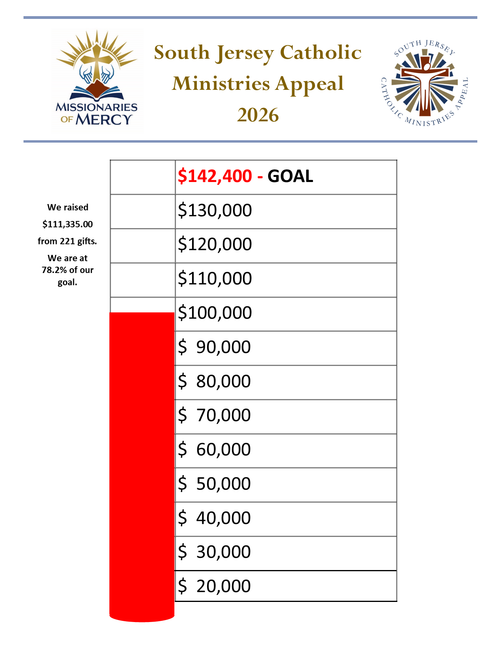
2026 South Jersey Catholic Ministries Appeal
By supporting the 2026 South Jersey Catholic Ministries Appeal, you are supporting many programs and ministries of the Diocese of Camden and Saints Peter & Paul Parish. These ministries serve the physical, emotional, and spiritual needs of the hungry and challenged. When you support the South Jersey Catholic Ministries Appeal, you offer comfort to those in your parish, your community, and throughout the entire Diocese.
This year’s theme, “Missionaries of Mercy,” supports the social and spiritual needs of our 62 parishes and 29 schools, with social services, hospital chaplaincy, youth & teen campus ministries, Catholic education, pastoral care initiatives, vocations, and faith formation programs.
Together we make a stronger community with faith, compassion, and mercy.
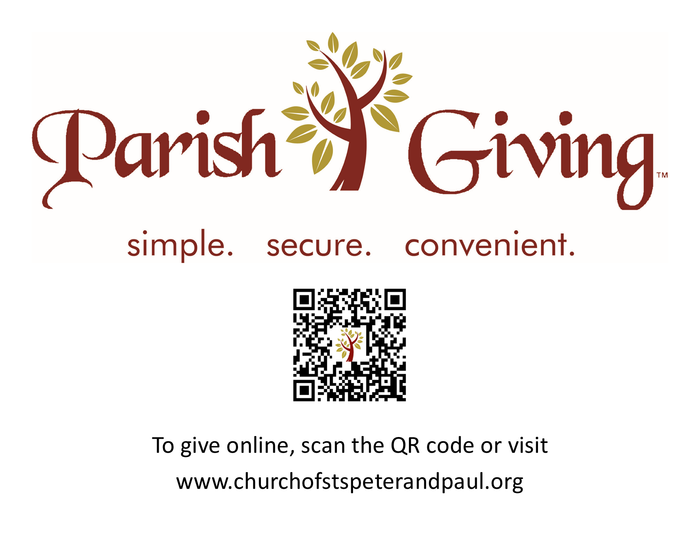
Quick, Easy and Secure Online Giving – Click on the link below to make a one-time gift or set up monthly installments, via credit, debit, or checking/savings transaction and to view video.
HOW DO I...
How Do I...?
-
How do I become a Catholic?Listenelement 1
The Order of Christian Initiation of Adults [OCIA]
Would you like a deeper understanding of the Catholic Faith? How about a closer relationship with God? If you or someone you know has been alienated from the church, we would love to welcome you back through the Order of Christian Initiation for Adults (OCIA; formerly the RCIA). We invite you and encourage you to invite those who have been away or have no church to call their own.
The Order of Christian Initiation of Adults is designed for:
• Those who desire to CONVERT to the Roman Catholic Faith.
• Those who have no church to call their own.
• Those who have NEVER been baptized.
• Catholics who have been Baptized, but HAVE NOT received First Eucharist and/or Confirmation
If you are interested or know someone who is, please contact the parish office at 856-589-3366 or office@churchofstspeterandpaul.org.
To register for OCIA, please complete the form and return it the parish office. OCIA Registration Form.
-
How do I register with the Parish?Listenelement 2
WELCOME TO SAINTS PETER AND PAUL PARISH
Please complete the Parish Registration form below. Be sure to click the link below and complete the requested information for each household member. Thank you.
-
How do I place a name on the prayer list?Listenelement 3
Please provide the name of the person(s) you wish to have added to our Prayer list. PLEASE NOTE: Names remain on the prayer list for six weeks. Should you need to have a name on the prayer list longer, please contact the parish office. If the name should need to be removed from the prayer list sooner, please contact the parish office.
-
How do I update my contact information?Listenelement 4
Complete the form to update your contact information.
-
How do I request a sacramental record?
Complete the form to request a sacramental record.
-
How do I request a Mass Card?
To request a Mass Card for an Unannounced or Announced Mass Weekend or Daily Mass, please provide the information requested below. Please note that Masses are frequently reserved up to six months in advance of today's date. We will make every attempt to provide you with the date that you are requesting but it may not always be possible to do so.
The suggested donation for each requested Mass is $10 for an Unannounced or $15 for an Announced. Please mail your donation to the Parish Office: PO Box 1022, Turnersville, NJ 08012 or place in our drop box located at the Parish Center. Your Mass card will be mailed to your home address within 5-7 day.
-
How do I request a sponsor letter?
Sponsor Letter For Baptism / Confirmation